Why peak summer is the real test for eco hotels
Peak summer is when every eco hotel promise meets reality. During the eco-hotel summer peak season 2026, properties run at full capacity while guests expect seamless service and authentic sustainability. For families choosing a luxury hotel, this is the moment when design, operations and ethics either align or unravel.
Global research shows that travelers are increasingly wary of crowded hotspots during the hottest seasons. Booking.com reports that 43% of travelers plan to avoid overcrowded destinations and 42% intend to travel outside peak season, yet July and August still fill guest rooms in the most desirable eco hotels. The question is not whether a hotel will be busy, but whether the property will maintain a low footprint when every suite, villa and family room is occupied.
True leaders in eco friendly hospitality design their hotels resorts around low density from day one. Vestige Can Jordi in Formentera caps capacity at only 25 suites, while Uganda’s Erebero Hills spreads its rooms and guest rooms across 45 acres to protect both wildlife and privacy. These hotels prove that an eco hotel can be fully booked in summer, yet still feel calm, spacious and rooted in the landscape.
Low density is not just an aesthetic choice for luxury hotels that care about impact. It is a structural decision that limits strain on water systems, renewable energy infrastructure and staff during the eco-hotel summer peak season 2026. Families feel the difference immediately, because the resort pool is never overcrowded, the spa remains serene and dining options stay relaxed rather than rushed.
Several new hotel openings are embracing this approach as a defining feature of their design. Six Senses Amaala, for example, is planning just 64 rooms and suites, supported by a zero impact desalination plant and a strict ban on single use plastics. This kind of resort will not chase maximum headcount in summer, because the resort will prioritise long term ecological health over short term volume.
In the United States, Ambiente Hotel in Sedona shows how a small adults only property can operate with Four Green Keys certification while still delivering a high touch luxury experience. The hotel will never feel like a mass market resort, because its rooms and guest rooms are integrated into the desert rather than stacked into a tower. During the eco-hotel summer peak season 2026, such properties will offer a quieter, more intentional rhythm even when every key is out.
Energy and water at capacity: how design keeps impact low
Energy and water systems are where the eco-hotel summer peak season 2026 becomes unforgiving. When every family is showering after the pool, every spa treatment is running and every kitchen is at full fire, weak infrastructure shows immediately. The most credible eco hotels design their properties so that full occupancy is the baseline scenario, not an occasional stress test.
Renewable energy is central to this resilience, especially for hotels resorts in sunny or windy regions. Six Senses Amaala combines solar power with advanced water treatment, proving that a resort will function cleanly even when all rooms suites are occupied. Nokken Hotel Cabins take another route, using modular, off grid eco cabins that rely on renewable energy systems sized precisely for each private unit.
Water is the second critical frontier during hot seasons when families live between sea views, showers and plunge pools. Zero impact desalination at coastal hotels reduces pressure on local aquifers, while low flow fixtures and greywater reuse quietly cut consumption behind the scenes. These measures matter most in summer, when an eco hotel might host twice as many guests as in shoulder seasons.
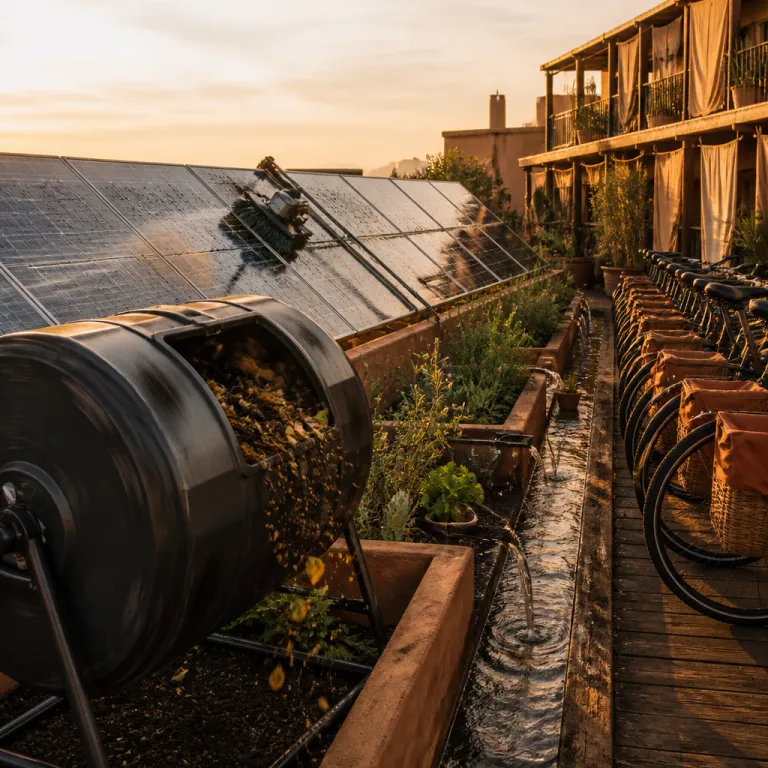
Waste management also scales sharply when a luxury hotel is full. Composting organic waste from dining and bar programs, eliminating single use plastics and partnering with local recyclers keep back of house operations aligned with front of house promises. As one industry explanation puts it clearly, “Hotels minimizing environmental impact through sustainable practices.”
Families choosing a resort for the eco-hotel summer peak season 2026 should look beyond the spa menu and the main pool. Ask whether the hotel will feature on site renewable energy, whether the resort will treat or reuse water and how the property handles food waste from its dining options. These questions separate genuine eco friendly operations from marketing language.
For travelers planning a European city and countryside itinerary, pairing a Venetian stay at a refined, water facing hotel in Dorsoduro with a rural retreat can balance culture and calm. In Tuscany, for example, several luxury hotels integrate vineyards, organic gardens and geothermal systems into their design, as highlighted in this guide to refined elegance at luxury hotels in Tuscany. Such properties will offer both character and credible sustainability when the mercury rises.
Low density, high value: why fewer guests can mean better stays
Limiting guest numbers is often framed as a constraint, yet in practice it is a strategy. During the eco-hotel summer peak season 2026, the most desirable eco hotels quietly cap occupancy to protect both the environment and the guest experience. This is where low density design, pricing and long term positioning intersect.
For families, fewer neighbors in the next rooms translate into calmer corridors, quieter pools and more attentive service. A seasons hotel that deliberately keeps its guest rooms count modest can maintain a relaxed atmosphere even when technically full. This approach is especially powerful on an island or in a fragile coastal city, where infrastructure and ecosystems are easily overwhelmed in hot seasons.
From a commercial perspective, a resort will often earn more per stay by focusing on value rather than volume. High yielding suites with private terraces, plunge pools and strong wellness programs attract guests who stay longer and spend more on spa rituals and dining. In this model, the hotel will offer curated experiences instead of chasing every possible booking during summer.
Properties like Ambiente Hotel in the United States and the modular Nokken Hotel Cabins show how small scale can still feel expansive. Their eco friendly architecture opens directly to nature, so the main feature is the landscape rather than a crowded lobby. Families booking for the eco-hotel summer peak season 2026 can expect space, silence and a more personal rhythm.
For urban luxury hotels, the same logic applies in a denser context. A city property that limits event sizes, staggers check in times and manages access to the spa and pool can keep energy use and water demand predictable. These hotels resorts also protect staff wellbeing, which in turn stabilises service quality when every room is sold.
Travelers tracking the evolution of sustainable luxury can look at curated rankings such as what Condé Nast Traveler’s European hotel picks reveal about the eco luxury shift. These lists highlight how luxury hotels are moving away from sheer scale and towards thoughtful, lower impact models. The eco-hotel summer peak season 2026 will likely accelerate this shift as demand concentrates on properties that balance capacity with conscience.
How to secure genuine eco stays for peak summer
Securing a room at a credible eco hotel during the eco-hotel summer peak season 2026 requires early, informed action. Families should start by identifying hotels that publish clear data on renewable energy use, water treatment and waste reduction. Vague language about being green is not enough when every tap, air conditioner and oven will be running in summer.
When researching hotels resorts, read beyond the headline amenities. Look for specific commitments such as solar arrays, geothermal systems, organic gardens, partnerships with local communities and recognised certifications like LEED or Green Key. Chains such as 1 Hotels in the United States and beyond have built their reputation on measurable environmental stewardship rather than slogans.
Direct questions are your best filter when planning a luxury hotel stay for peak seasons. Ask whether the hotel will offer family friendly wellness programs that avoid single use plastics, whether the resort will feature locally sourced dining options and how the property manages energy during heatwaves. Serious eco hotels answer these questions with operational detail, not marketing phrases.
Families traveling for major events, from regional festivals to global tournaments like the FIFA Cup, should be especially selective. Host cities often see a rush of temporary hotel openings that prioritise speed over sustainability, while established eco hotels quietly maintain standards. Choosing the latter supports long term investment in eco friendly infrastructure rather than short term builds.
Once you have a shortlist, book early and be flexible on dates within the broader summer window. Many seasons hotel properties release rooms in waves, rewarding guests who commit before the calendar fills. Consider midweek arrivals, longer stays and connecting rooms suites to reduce turnover and make better use of the hotel’s resources.
Finally, align your own behaviour with the property’s efforts during the eco-hotel summer peak season 2026. Participate in hotel led sustainability initiatives, respect local water guidelines and use wellness facilities like the spa and pool mindfully. As one guidance for travelers puts it succinctly, “Why choose eco-friendly accommodations? To support environmental conservation and sustainable tourism.”
FAQ
What defines an eco friendly hotel during peak summer ?
An eco friendly hotel in peak summer is a property that can operate at full occupancy while keeping energy, water and waste impacts measurably low. This usually involves renewable energy systems, efficient guest rooms, responsible dining and strong partnerships with local communities. The key is that sustainable practices hold up when every room is occupied, not only in quieter seasons.
How do eco hotels maintain luxury standards without compromise ?
Eco hotels maintain luxury by integrating sustainability into the core design rather than adding it later. High quality materials, generous room sizes, private outdoor spaces and thoughtful wellness facilities are planned alongside solar panels, water treatment and waste systems. As one clear explanation states, “How do eco-hotels maintain luxury standards? By integrating sustainable practices without compromising comfort.”
Why should families choose eco hotels for the eco-hotel summer peak season 2026 ?
Families benefit from eco hotels in peak summer because low density design and efficient systems create calmer, healthier stays. These properties often have better air quality, quieter pools and more attentive service, since staff are not overwhelmed by excessive guest numbers. Choosing such hotels also supports destinations that prioritise long term environmental health over short term volume.
How can I verify that a hotel’s sustainability claims are genuine ?
To verify claims, look for recognised certifications, transparent reporting and specific operational details. Ask how much of the property’s energy comes from renewable sources, how water is treated and whether waste is composted or recycled. Genuine eco hotels answer with numbers and processes, while greenwashed hotels rely on vague language.
Is it harder to find eco hotels in cities than on islands or in remote areas ?
Urban eco hotels face different constraints, but many city properties now match or exceed the standards of island and rural resorts. Look for hotels that retrofit efficient systems, reduce car dependence and support local food networks through their dining programs. In all locations, the most reliable indicator is a clear, audited sustainability strategy rather than the setting alone.